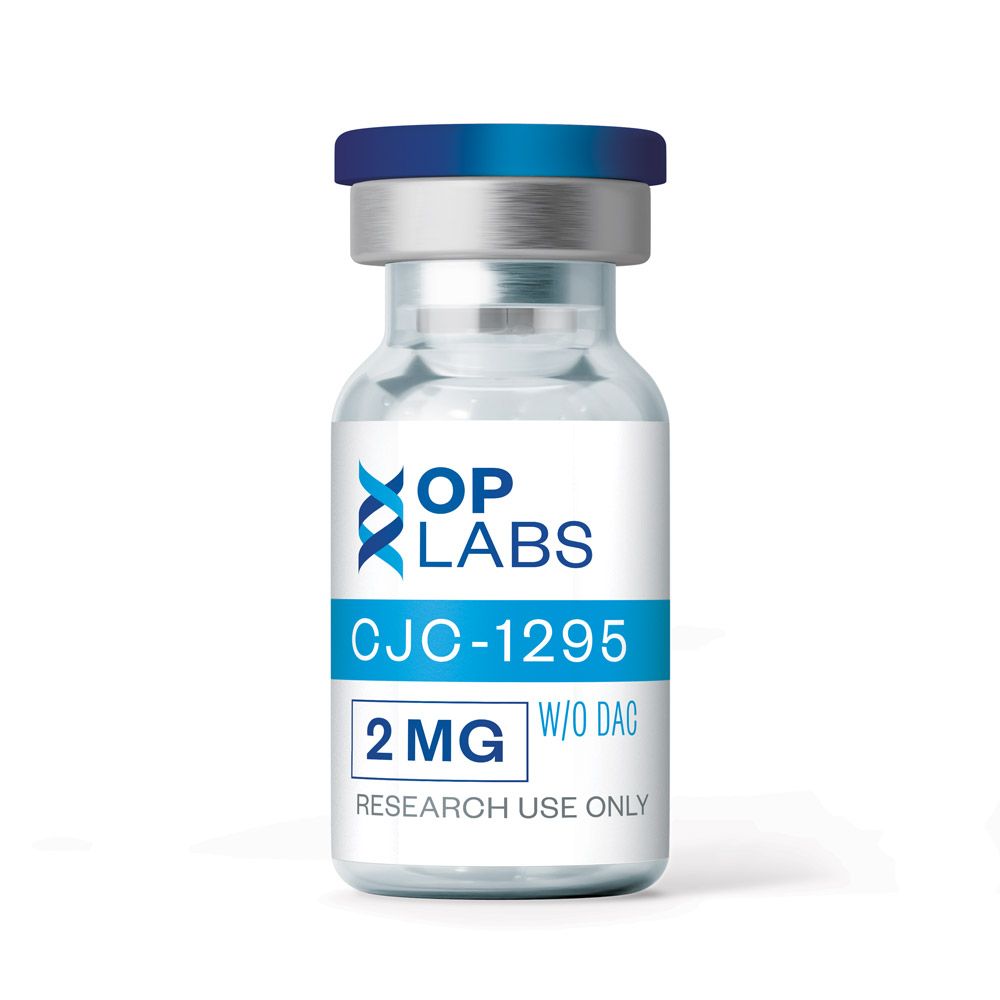
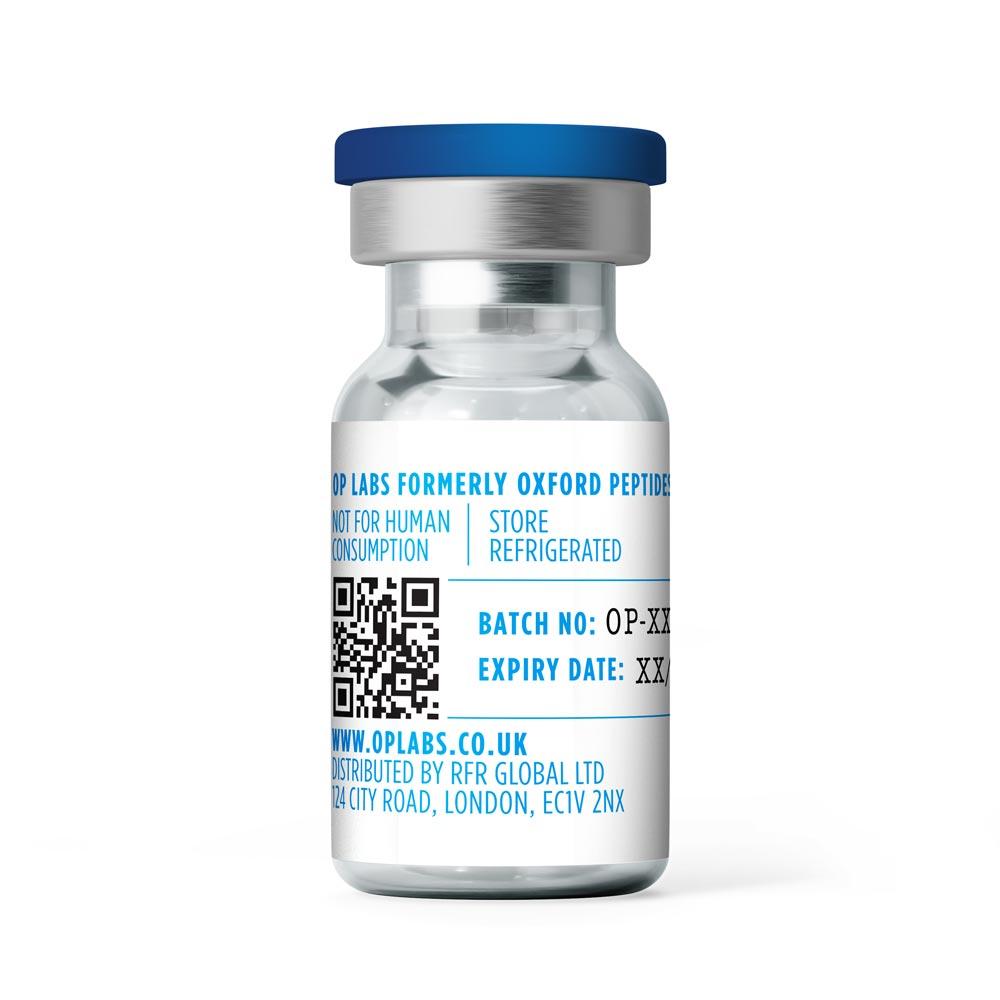


- OP Labs formerly Oxford Peptides.
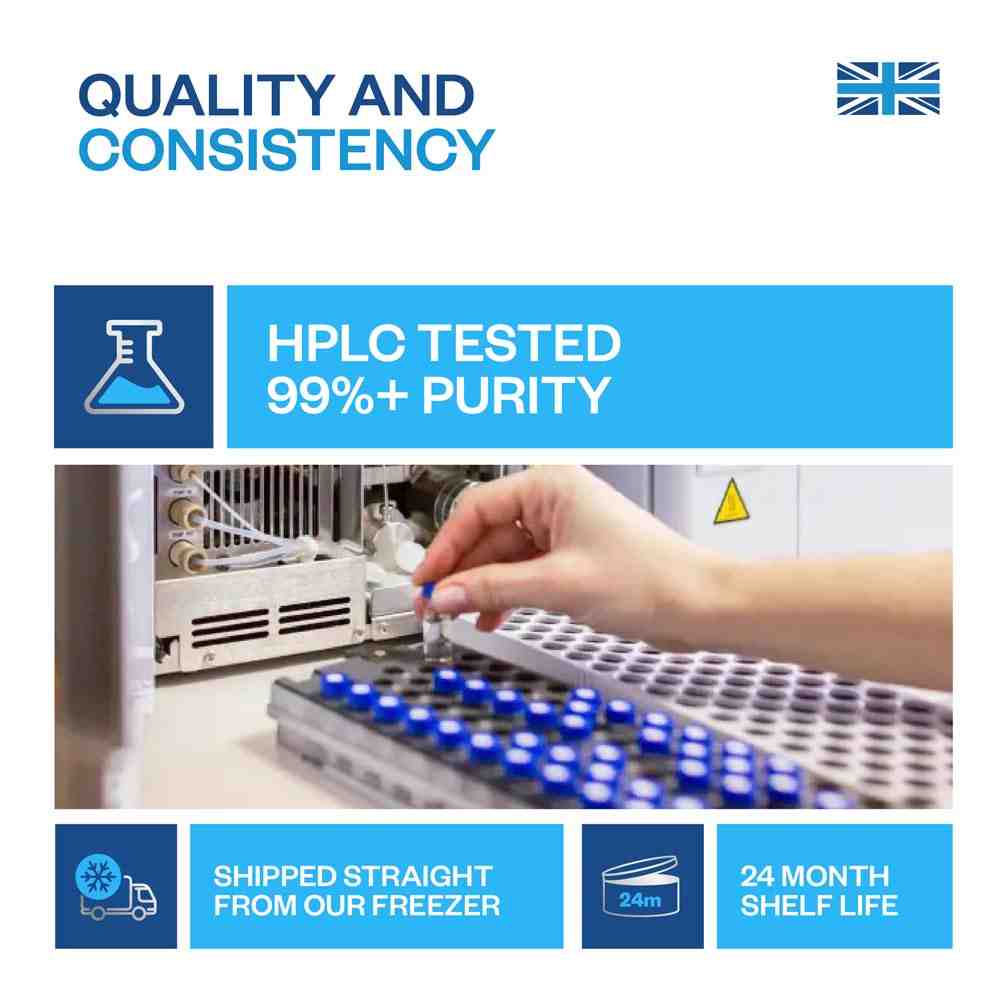
- Batch HPLC tested at 99%+ purity.
- Store frozen long term or in fridge when ready to be used.
- Sold for research purposes only.
- Contact us for Wholesale Orders.
Download COA here: CJC-1295 without DAC COA.pdf
Please note if you have a different Batch ID please contact us for the latest COA.
CJC-1295 (Without DAC)
Synonyms: CJC-1295, Modified GHRH (1–29) analogue, Tetrasubstituted GHRH (1–29), Growth Hormone–Releasing Hormone analogue.
Molecular Formula: C152H252N44O42
Molecular Weight: 3367.9 g/mol (approximate)
CAS Number: 446262-90-4
Peptide Classification: Synthetic growth hormone–releasing hormone (GHRH 1–29) analogue.
Solubility: Soluble in sterile water, acetic acid, and physiological buffers (e.g., PBS)
Description & Mechanism
CJC-1295 without DAC is a synthetic analogue of growth hormone–releasing hormone (GHRH 1–29) incorporating amino acid substitutions designed to enhance stability relative to the native peptide. Unlike DAC-conjugated variants, CJC-1295 does not contain a drug affinity complex and therefore exhibits pharmacokinetic behaviour characteristic of non-conjugated GHRH analogues in experimental systems.
In biochemical and cellular research models, CJC-1295 interacts with the GHRH receptor expressed on pituitary-derived cells, initiating intracellular signalling cascades associated with endocrine regulation. Preclinical and clinical research has examined receptor binding properties, activation kinetics, and downstream signalling under short-duration exposure conditions. Observed molecular and physiological responses are dependent on experimental design, concentration, and model system, and are used to investigate GHRH receptor signalling rather than defined biological or physiological outcomes.
Applications in Research
- As a molecular probe to study GHRH receptor binding and activation dynamics.
- Investigation of growth hormone axis signalling and endocrine feedback mechanisms.
- In cellular assays examining downstream transcriptional and signalling responses.
- In preclinical or clinical research models assessing extended peptide–receptor interaction resulting from albumin association.
Handling, Reconstitution & Stability
- Weigh under dry conditions; peptide is hygroscopic.
- Reconstitute in sterile water or appropriate buffered aqueous solution depending on assay requirements.
- Avoid vigorous agitation during dissolution due to peptide–DAC conjugation.
Filter sterilize if required (e.g. 0.22 µm) immediately prior to use. - Aliquot and store reconstituted solutions at –20 °C (or lower) to avoid repeated freeze–thaw cycles.
- Inspect solutions for precipitation or changes in clarity before use in sensitive assays
Specifications Summary
| Parameter | Typical Value / Range |
|---|---|
| Purity (HPLC) | ≥ 98% |
| Appearance | White to off-white lyophilised powder |
| Molecular Weight | ~3,647.9 g/mol |
| Peptide Type | Synthetic GHRH analogue with DAC |
| Solubility | Water, buffered aqueous solutions |
| Storage | –20 °C, desiccated, dark |
| Pack Size | 2 mg |
References
- Teichman, S. L., Neale, A., Lawrence, D., et al. (2006). “Prolonged stimulation of growth hormone (GH) and insulin-like growth factor I secretion by CJC-1295, a long-acting analog of GH-releasing hormone.” Journal of Clinical Endocrinology & Metabolism, 91(3), 799–805. https://doi.org/10.1210/jc.2005-1536
- Wu, Z., et al. (2009). “Synthesis and characterization of growth hormone releasing hormone analogues.” Peptides, 30(5), 783–789. https://doi.org/10.1016/j.peptides.2009.01.010
- Frohman, L. A., Downs, T. R., Heimer, E. P., et al. (1989). “Studies of the biological activity of analogs of growth hormone-releasing factor (GRF).” Endocrinology, 124(1), 279–284. https://doi.org/10.1210/endo-124-1-279
- Camanni, F., Ghigo, E., Arvat, E. (1998). “Growth hormone-releasing peptides and their analogs.” Frontiers in Neuroendocrinology, 19(1), 47–72. https://doi.org/10.1006/frne.1997.0166
Keywords: CJC-1295 without DAC, CJC without DAC, CJC no DAC, CJC1295 no DAC, CJC1295 without DAC.