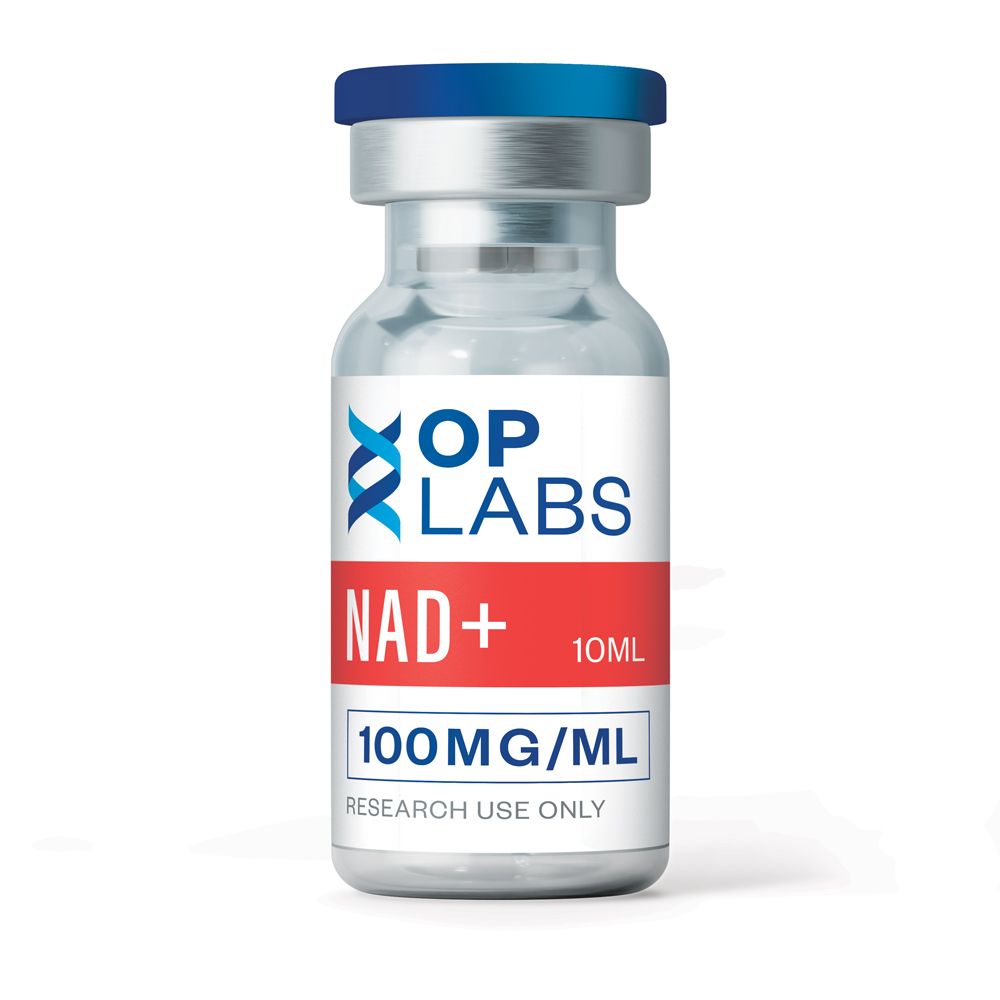
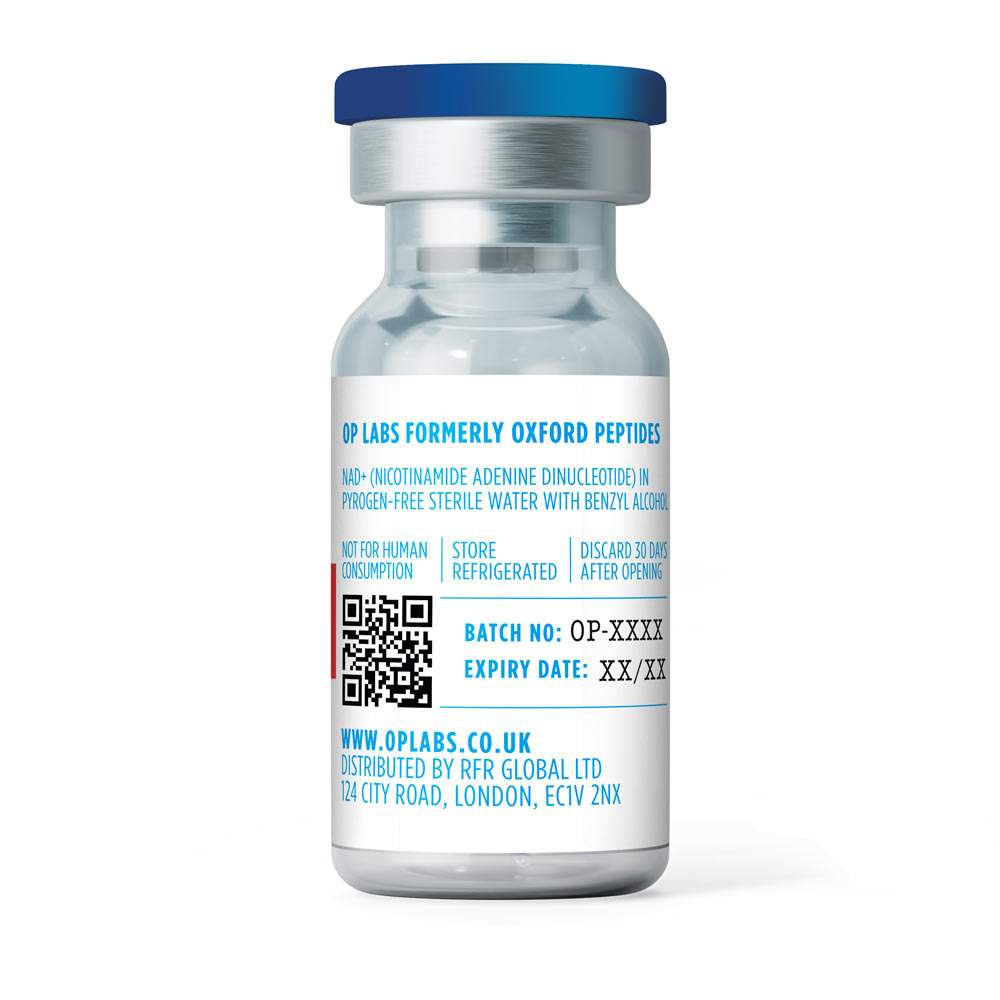

- OP Labs formerly Oxford Peptides.
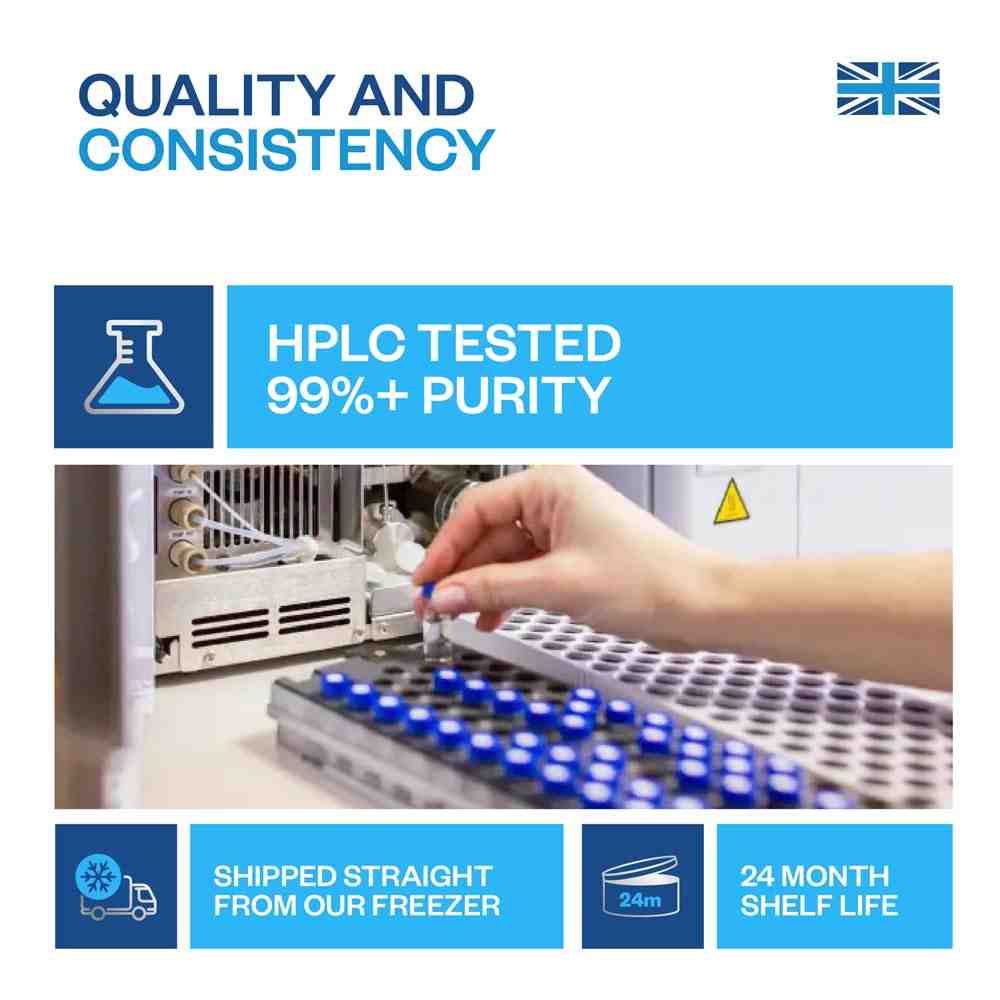
- Batch HPLC tested at 99%+ purity.
- Store in a cool dark place
- Sold for research purposes only.
- Contact us for Wholesale Orders.
Download COA here: NAD+_COA.pdf
Please note if you have a different Batch ID please contact us for the latest COA.
NAD+
Synonyms / Designations: NAD+, Nicotinamide Adenine Dinucleotide (oxidised form), b-NAD+
CAS Number: 53-84-9
Molecular Formula: C21H27N7O14P2
Molar Mass: ~663.43 g/mol
Chemical Classification: Pyridine nucleotide coenzyme
Purity: 99 % (HPLC, typical)
Appearance: Clear liquid
Pack Size: 10ml
Storage: Store in a cool dark place. Discard 30 DAYS after opening.
Description & Mechanism
Nicotinamide adenine dinucleotide (NAD+) is an endogenous pyridine nucleotide that functions as a central redox cofactor and signalling molecule in cellular metabolism. In its oxidised form, NAD+ participates in electron transfer reactions fundamental to oxidative phosphorylation, glycolysis, and mitochondrial energy production.
In biochemical and cellular research systems, NAD+ is extensively studied for its role in redox balance, substrate availability for NAD+-dependent enzymes, and regulation of intracellular signalling pathways. These include sirtuins, poly(ADP-ribose) polymerases (PARPs), and cyclic ADP-ribose–generating enzymes involved in DNA repair, chromatin regulation, and calcium signalling. Experimental outcomes are influenced by intracellular NAD+/NADH ratios, compartmentalisation, and metabolic state of the model system.
Applications in Research
• Investigation of cellular redox metabolism and mitochondrial function
• Studies of NAD+-dependent enzymes including sirtuins and PARPs
• In vitro research on energy homeostasis and metabolic signalling pathways
• Use as a reference compound in enzymology and metabolic research
Handling & Stability
- Store in a cool dark place. Discard 30 DAYS after opening.
- Shelf life: 30 MONTHS from production
Specifications Summary
Purity: 100mg/ml
Appearance: Clear liquid
Chemical Type: Pyridine nucleotide coenzyme
Molecular Weight: ~663.43 g/mol
Storage: Store in a cool dark place. Discard 30 DAYS after opening.
Pack Size: 10ml
Precautions & Notes
- Experimental behaviour of NAD+ is influenced by pH, temperature, and redox environment.
- NAD+ is sensitive to hydrolysis under acidic or basic conditions.
- Appropriate controls are recommended when interpreting enzyme-dependent effects.
- Intended strictly for laboratory research use only; not for human or veterinary application.
References
Verdin E. NAD⁺ in aging, metabolism, and neurodegeneration. Science, 2015.
https://pubmed.ncbi.nlm.nih.gov/26785480/
Covarrubias A.J. et al. NAD⁺ metabolism and its roles in cellular processes during ageing. Nature Reviews Molecular Cell Biology, 2021.
https://www.nature.com/articles/s41580-020-00313-x
Rajman L. et al. Therapeutic potential of NAD-boosting molecules: the in vivo evidence. Cell Metabolism, 2018.
https://pubmed.ncbi.nlm.nih.gov/29514064/
Braidy N., Liu Y. NAD⁺ therapy in age-related degenerative disorders: a benefit/risk analysis. Experimental Gerontology, 2020.
https://pubmed.ncbi.nlm.nih.gov/31606488/
Keywords :NAD+, Nicotinamide Adenine Dinucleotide, Pyridine Nucleotide, Redox Cofactor, Mitochondrial Metabolism, Enzymology, Metabolic Research